
01
What Is Due Diligence When Buying a Business?
Every offer rests on a set of assumptions. The buyer assumes the reported earnings reflect what the business actually produces, that revenue will continue after the sale, that the assets in the listing are owned and functioning, that the obligations are known, and that the operation can run without the person currently running it. Due diligence is where those assumptions are tested against evidence.
It is a verification exercise rather than a search for reasons to withdraw. Most businesses that reach this stage have a mixture of strengths and issues. The point of diligence is to find out which is which, early enough that the findings can inform price, structure, conditions or the decision itself.
“Assumption, evidence, verification, decision. Diligence is the step that connects the four.”
This article covers the buyer side review. The wider acquisition journey, from defining criteria through offer and closing, is covered in buying a business.
02
What Should a Buyer Verify During Due Diligence?
The scope of a review varies with the business, but the structure rarely does. A buyer is trying to move each element of the deal from something stated to something supported.
- Verify the earnings. Confirm that reported performance can be traced to independent records and that adjustments are legitimate.
- Understand the risks. Identify where revenue, operations or relationships are concentrated, and what would disturb them.
- Confirm what transfers. Establish which assets, contracts, licenses and obligations move to the buyer, and on what conditions.
- Test continuity. Determine whether the business can operate after the current owner steps away, and what the transition requires.
The sections that follow work through the areas a buyer commonly examines. They are numbered for navigation rather than sequence. In practice several run at once, and findings in one area regularly send the review back into another.
03
Financial Statements
The financial review normally begins with profit and loss statements and balance sheets for the periods the seller has provided. The first task is not analysis but comprehension: understanding how the business records revenue, what sits in each expense category, and whether the presentation is consistent from one period to the next.
Consistency matters more than polish. Statements that change categorization between periods, or that move material amounts into general accounts, make it harder to see the trend. Where results move sharply, the explanation should be identifiable in the records rather than only in conversation.
04
Normalized Earnings and Add-Backs
Privately held businesses are commonly evaluated on normalized earnings rather than reported net income. For owner operated companies that measure is usually Seller's Discretionary Earnings, and for management led companies it is more often EBITDA. Normalization separates the ongoing economics of the business from owner specific, discretionary or non-recurring items.
Add-backs are where a buyer review often concentrates. Each adjustment should be identifiable in the records, and the reasoning behind it should hold. An expense that will continue under new ownership is not an add-back. An expense removed from the accounts should also raise the question of what replaces it: below-market owner compensation, for instance, generally needs to be restated at the cost of the person who would actually do the work.
How multiples are then applied to those earnings is a valuation question rather than a diligence question, covered in valuation multiples explained and the San Antonio business valuation guide.
05
Tax Returns, Statements and Underlying Records
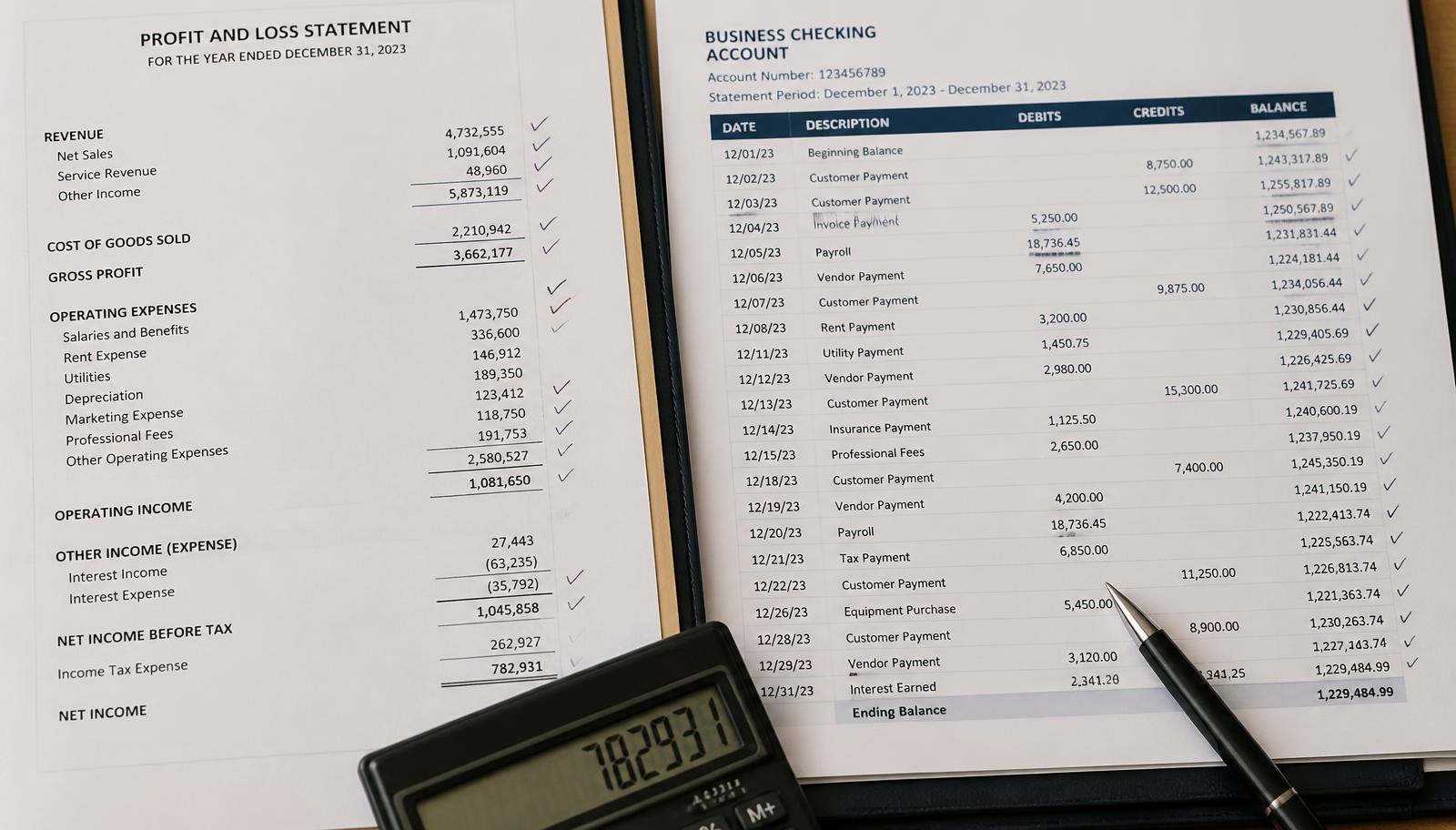
A single source of financial information cannot verify itself. The comparison that carries weight is between the internal statements, the filed tax returns and the underlying activity in bank and processing records. Where those three sources agree, or differ for reasons that can be explained, confidence in the numbers increases.
Differences are not automatically a problem. Timing, accounting method and legitimate book to tax adjustments all produce them. What matters is whether the difference can be explained and traced. A gap that nobody can account for is a finding in itself, regardless of its size.
06
Revenue Quality and Customer Concentration
Two businesses can report the same revenue and carry very different risk. A buyer generally looks behind the total to see where it comes from, how repeatable it is, and how much of it depends on a small number of relationships.
Useful questions include how revenue is distributed across customers, how long those customers have been with the business, whether the relationships are contracted or discretionary, whether they attach to the company or to the departing owner personally, and how new customers are acquired. Concentration is common in small businesses and does not disqualify a deal, but it does change the risk being purchased and often influences structure.
07
Employees, Management and Owner Dependence
The people review looks at who does the work, who holds the knowledge, and what happens when the owner is no longer there. Employee roles, tenure, compensation and any agreements in place all matter, as does the practical question of which positions would be difficult to replace.
Owner dependence deserves specific attention. A buyer benefits from mapping what the current owner actually does across sales, pricing, approvals, key relationships, technical work and financial control. Where a function has no second holder, the transition plan has to address it. Employment terms and the enforceability of restrictive covenants are matters for the buyer's attorney rather than assumptions made from a staff list.
08
Contracts and Commercial Agreements
Contracts define much of what a buyer is actually acquiring. The review usually covers customer agreements, supplier and vendor terms, distribution or licensing arrangements, service agreements and any franchise documentation where it applies.
Two provisions carry particular weight in a sale: assignment clauses, which govern whether an agreement can move to a new owner, and change of control clauses, which can allow a counterparty to renegotiate or terminate. A contract that cannot transfer without consent is not a defect, but it is a condition, and it belongs in the closing plan rather than in the assumptions.
09
The Commercial Lease
For location dependent businesses the lease can be as important as the financial statements. The relevant points generally include the remaining term, renewal options and how they are exercised, rent and scheduled increases, the assignment provisions, whether the landlord must consent to a transfer, any personal guarantee, and responsibility for maintenance, insurance and property costs.
A short remaining term or an uncertain renewal changes the economics of a location based business. Landlord consent, where required, is best raised early rather than discovered near closing.
10
Business Assets
The asset review confirms what exists, what condition it is in, who owns it and whether anything is secured against it. Equipment, vehicles, fixtures, inventory and any specialized systems are normally inspected rather than accepted from a schedule.
Ownership is a separate question from possession. Some assets on site may be leased, financed or subject to a recorded lien. Inventory warrants its own look: quantity, valuation method and whether the stock is actually saleable. Deferred maintenance and near-term replacement needs are a real cost of ownership even when they never appear in the earnings presented.
11
Debt and Liabilities
A buyer needs a complete picture of what the business owes and which obligations survive the transaction. That commonly includes bank debt and lines of credit, equipment finance, accounts payable, accrued expenses, tax liabilities including payroll and sales tax, customer deposits, gift cards or prepaid work, and warranty or return obligations.
Whether liabilities transfer depends heavily on how the deal is structured. Asset and equity purchases treat obligations differently, and successor liability rules can apply in specific circumstances. This is a legal question, and it is one of the clearest reasons a transaction attorney belongs in the process.
12
Working Capital
Working capital is one of the more frequently overlooked areas of a first acquisition. A business needs a certain level of receivables, inventory and cash to operate normally, and if it transfers without that cushion the buyer has to fund it immediately alongside the purchase price.
The practical work is to understand the level the business normally carries, how it moves through the year, and what the purchase agreement says about the amount to be delivered at closing. Receivables deserve their own review, including how old they are and how reliably they have been collected.
13
Licenses, Permits and Regulatory Standing
Many businesses can only operate with specific licenses, permits or registrations at state, county or city level, and requirements differ by industry and location. The diligence question is not only whether they are current, but whether they transfer with the business, must be reissued to the new owner, or depend on a qualification the buyer does not yet hold.
Where a license attaches to an individual rather than to the entity, timing becomes part of the transaction plan. Confirmation should come from the issuing authority or the buyer's advisors rather than from a general assumption about the industry. In Texas, regulated occupations and businesses are licensed by different state agencies, listed in the Texas.gov occupational and professional licensing directory, and confirming license status with the issuing agency is a useful first step.
14
Legal and Dispute History
The legal review covers current, threatened and recent litigation, regulatory matters, employment claims, insurance history and any disputes with customers, suppliers or the landlord. The purpose is to understand exposure that could follow the business or the buyer after closing.
Findings here often shape the agreement rather than the price. Representations and warranties, indemnities, escrow or holdback provisions and closing conditions are the usual mechanisms for handling a known issue, and drafting them is work for a transaction attorney.
15
Technology, Systems and Intellectual Property
Most businesses depend on systems that are easy to overlook until they need to transfer: accounting and point of sale software, booking or scheduling platforms, customer databases, websites, domains, hosting, social accounts, phone numbers and business listings.
The buyer should establish what is owned, what is licensed, what is subscribed, and whether each item can move to new ownership. Trademarks, trade names, recipes, designs, proprietary processes and customer data all deserve explicit treatment in the agreement. Credentials themselves are a closing and transition matter, handled securely at the appropriate stage rather than circulated during the review.
16
Confirm Exactly What Is Included in the Sale
The final verification is the simplest to describe and the easiest to leave until too late: a written, specific schedule of what is included and what is excluded. Equipment, vehicles, inventory, intellectual property, customer lists, contracts, deposits, cash and receivables should all appear somewhere on that schedule.
Alongside it sit the transition terms. How long the seller will remain available, in what capacity, whether training is defined, and what restrictions apply to the seller afterwards. Assumptions about any of these are the ones most likely to surface as a disagreement after closing.
17
Business Acquisition Due Diligence Checklist
The following summarizes the areas discussed above in review format. It is general and illustrative rather than a complete list for any particular transaction. The items that apply to a specific business depend on its industry, size, structure, location and the terms being negotiated.
01
Financial
- Profit and loss statements for the periods provided
- Balance sheets and supporting schedules
- Filed tax returns for the same periods
- Bank statements and merchant processing records
- Payroll records and employee cost detail
- Support for every claimed add-back
02
Revenue and Customers
- Revenue by customer, product or service line
- Customer concentration and length of relationships
- Recurring versus one-time revenue
- Pricing history and current pricing commitments
- Sales pipeline and how new customers arrive
03
People
- Employee roster, roles, tenure and compensation
- Management responsibilities and decision authority
- Owner involvement in daily operations
- Employment, contractor and non-compete agreements
- Any position that would be difficult to replace
04
Contracts and Leases
- Customer, supplier and vendor agreements
- Assignment and change of control provisions
- The commercial lease and any renewal options
- Landlord consent requirements
- Franchise, licensing or distribution agreements where applicable
05
Assets
- Equipment, vehicles and fixtures with condition notes
- Inventory quantity, valuation and saleability
- Ownership evidence and any liens recorded
- Leased assets and what happens to them at closing
- Deferred maintenance or replacement needs
06
Liabilities
- Bank debt, equipment finance and lines of credit
- Accounts payable and accrued obligations
- Tax liabilities, including payroll and sales tax
- Customer deposits, gift cards and prepaid work
- Warranty, refund or return obligations
07
Legal and Regulatory
- Licenses and permits required to operate
- Whether those licenses transfer or must be reissued
- Litigation, claims and regulatory matters, current or threatened
- Insurance history and claims record
- Industry or location specific compliance requirements
08
Transaction
- Asset or equity structure and what that changes
- Schedule of included and excluded assets
- Working capital expected to remain in the business
- Transition and training arrangement with the seller
- Conditions that must be satisfied before closing
18
What Are Common Red Flags When Buying a Business?
Concerns raised most often in a buyer review include records that cannot be reconciled with tax returns or bank activity, add-backs without support, revenue concentrated in a few customers, obligations that were not disclosed, leases or contracts that may not transfer, licenses tied to the current owner, unresolved legal or tax matters, and a business whose relationships and know-how sit almost entirely with the person leaving.
None of these ends a transaction by itself. Each one changes what is being bought, and the useful response is to understand it, size it and decide how it should be reflected in price, structure or conditions. The pattern that tends to matter more than any individual item is a seller who cannot produce support for the things being claimed.
19
Can Due Diligence Change the Deal?
It regularly does. When findings differ from what was presented, the parties may adjust the price, change the structure, move part of the consideration into an escrow or holdback, add specific representations and warranties, make closing conditional on a consent or a resolution, or agree that the transaction should not proceed.
This is a normal part of a transaction rather than a breakdown in it. A letter of intent generally reflects what the parties understood at the time it was signed. Diligence is the stage where that understanding is corrected, and the agreement follows the corrected version.
20
How Long Does Business Due Diligence Take?
There is no universal timeline, and figures quoted as standard should be treated with caution. The period is normally defined in the letter of intent or the purchase agreement, and the actual duration depends on the size and complexity of the business, the quality and availability of records, how responsive the seller is, whether a lender is involved and what the review uncovers.
What a buyer can influence is preparation: knowing which questions matter, having advisors engaged before the period starts, and requesting information in an organized sequence rather than piecemeal.
Working through an acquisition and want the process organized before the review period begins? You can speak with our San Antonio team about how a transaction is typically coordinated.
21
Who Should Be Involved in Business Due Diligence?
Buyers commonly work with an accountant or CPA on the financial review and a transaction attorney on the legal review. Depending on the business, other specialists may be appropriate, including environmental consultants for certain premises, industry regulatory advisors, insurance advisors and technology specialists. Where financing is involved, the lender will conduct its own review as well.
Advisors verify and interpret. The commercial judgment, whether the business fits the buyer's objectives, capabilities and risk tolerance, stays with the buyer. Nothing in this article is accounting, tax or legal advice for a specific transaction.
22
Does a Business Broker Perform Due Diligence for the Buyer?
No. A broker facilitates the transaction. That usually means coordinating information requests between the parties, keeping the process organized and moving, and helping both sides work through each stage toward closing. It does not include verifying financial records, providing accounting, tax or legal advice, or issuing an opinion that the information is accurate.
What a broker's role actually covers is set out in what a business broker does, which also covers what to consider when evaluating a broker before engaging one.
23
How Due Diligence and Financing Fit Together
Where a purchase involves borrowing, the lender runs a parallel review of the business, the buyer and the proposed structure, and its requirements can affect documentation, timing and terms. Financial information that cannot be supported during diligence may also affect what a lender is willing to advance.
The financing paths available to a buyer, and what each one generally requires, are covered separately in financing a business purchase.
24
Due Diligence When Buying a Business in San Antonio
The framework above applies wherever a business is located. A few practical points come up more often in San Antonio transactions. Licensing and permitting requirements can sit at state, county and municipal level at the same time, so confirming which apply and whether they transfer is worth doing early. Commercial lease terms carry particular weight for location dependent businesses here, and landlord consent is a common condition in a sale.
Businesses with international customers, suppliers or ownership may add documentation to the review, and some premises raise property specific matters such as insurance history or condition. Entity status and standing for a Texas business can be confirmed directly through the Texas Secretary of State, and a business's IRS employer identification number can be verified using guidance from the IRS. These are practical considerations to raise with local advisors rather than a different process. The wider local buyer context sits in the guide to buying a business, and how a valuation is approached locally is covered in the business valuation service.
Common questions
Frequently Asked Questions
Buyer advisory
Evaluating a Business Acquisition?
If you are reviewing an opportunity and want the process coordinated properly, the team at Supreme Capital Business Brokers San Antonio works with buyers through each stage of a transaction, alongside the accountant and attorney who carry out the verification work.
Request a Confidential Business Valuation
Tell us about your business and we'll contact you to discuss the valuation and the information needed to evaluate it.
Continue reading